Search This Blog

Showing posts with label nalbinding. Show all posts

Wednesday, February 27, 2019

Itsy-bitsy teeny-weeny sock

Here's my latest adventure in nalbinding. 

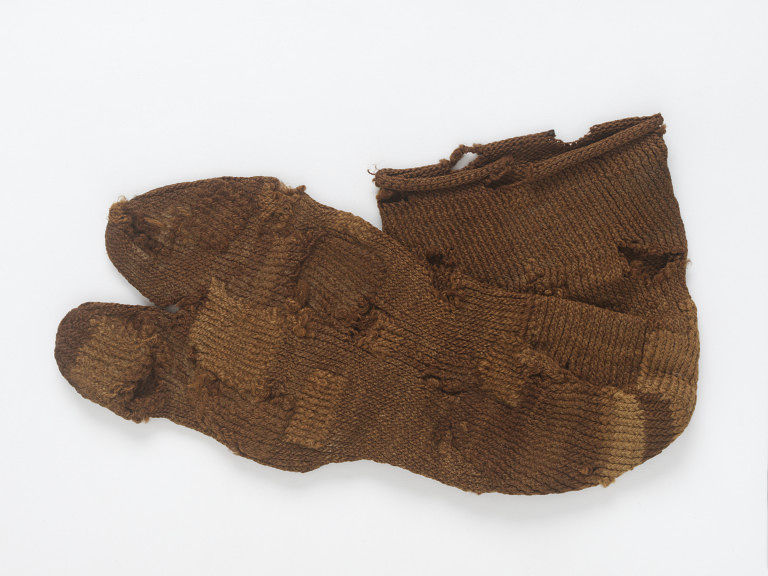
I decided to try and replicate this red and yellow sock in pierced looping from the V&A (item # 1287-1904). The idea here was to give myself another "reality check" on gauge. I am happy to say that I have finally gone overboard on doing tiny gauge work! I got some cones of weaving yarn (this one for the curious). When I measured, I got 22 wraps/in, which is what it's advertised as. 

I chose this sock because the museum has very good photos from multiple angles, making it possible to attempt to count stiches and rows.  Based on the V&A's photos, I counted rows and stitches as best I could. This stitch is pretty easy to count, though, in part because it is one of only 2 nalbinding stitches I know that lines up into vertical columns (the other being the typical Coptic stitch). Then, I tried to make a sock with the same number of rows and stitches. 

The V&A's sock is listed as being 12.5cm long, 6.7cm wide, and 4.5cm high. I'm not sure what 'height' means here, so I'm sticking with the other two. Based on counting rows and stitches in the museum's photos, I estimated this sock should be 4.77 st/cm or 12 st/in. I pretty much hit that mark with the weaving yarn. 

My sock, top view - I have stuffed it with a bit of brown paper to mimic the stuffing in the pictures of the V&A sock.

Top view of the V&A's sock

However, my sock is only 12.0cm long (from tip of toe to tip of heel) and 5.3cm wide (flattened out completely, across the instep). As you can see in the photos, it's narrower in relaton to its length than the V&A sock.  So, I may have undercounted the number of stitches around. But, I don't think I've made any error on the number of rows visible on the sole. Which means that I've probably found yarn that's (probably) too thin compared to the archaeological samples. This is useful.  

The sole of my sock

The sole of the V&A's sock

As you can see in the photo below, without something inside the sock, it curls up very tightly in an S-twisted direction. The stitches themselves are Z-twisted (F2 -/O in Hansen notation). I did counteract the twist in the yarn as I was working, but I doubt I balanced perfectly.  Those of you with sharp eyes may notice that the V&A's sock has S-twisted stitches, but I find it easier to work this way.  Regardless, the nature of the stitch leads to twisting, as with all nalbinding.  Since the museum has not posted a photo of their sock unstuffed, I can't compare.  This is unfortunate, since seeing the degree of twisting might have given me some idea about relative tension.  


The other really interesting thing here is that the waffle-like texture is MUCH less noticable at this gauge than in my sample with worsted weight wool. This has a pretty smooth texture in the finished product, though not as smooth as standard Coptic stitch. I would totally consider making a pair of socks in this stitch instead of regular Coptic when I get around to making another full size pair.


So, what did I learn from this little experiment?  I already knew that the gauge on surviving socks in Coptic stitch ranges approximately from 8-12 stitches per inch.  My previous efforts, using fingering/sock weight yarn (which was 16 wraps/inch) got me about 8.5 stitches/inch.  With this yarn (22 wraps/inch) my end result is about 12 stitches/inch.  So, this suggests that the yarns in the surviving socks are generally in the range of 16-22 wraps/inch (maybe as thick as 14, since the 16 wpi yarn gave me something slightly finer than the coarsest of the museum socks).  This is useful information, since yarn thickness is not generally a piece of information that museums report (many don't even report gauge and my figures are based in large part on estimating from reported measurements and photos).  It would be interesting to compare this to information on yarn size in contemporary woven textiles - but that will have to be someone else's project. 


Thursday, November 01, 2018

Stitch variants among Egyptian nalbound socks


So, in speaking with people (both online and IRL) about the nalbound socks from Egypt, there seems to be a lot of interest in the different stitch types that were used. While I did discuss the different types of stitches a bit in my previous post (here) I didn't really explore in detail all the different types of stitches that have been documented in detail.

The text that I used as the basis for that post was part of the explanatory material of a poster-style display I put together. The display included samples of all the different stitch types. I still feel that being able to feel the differences in texture and thickness makes a huge difference in appreciating the variety that can be achieved with different nalbinding techniques. However, a lot of information can be gleaned from pictures. So, I'm putting up some photos of my stitch samples. Hopefully, this will be of interest to someone other than me. :- )

All of the samples in this post were done with a commercial yarn in worsted weight. (Brown Sheep's Nature Spun, for those who are interested) This is much coarser than the yarn in any of the surviving socks from the post-Roman era. But, I felt that it was useful to use a larger yarn in these samples.


Coptic stitch and its variant

The most common stitch found among the Egyptian socks is referred to by most nalbinders as the 'Coptic stitch'. It is also sometimes called the 'Tarim stitch' in reference to a very old hat found in the Tarim basin of western China. The vast majority of the Roman-era and post-Roman socks from Egypt are made in the Coptic stitch. This is the stitch that very closely resembles knitting. Here are photos of my Coptic stitch sample:
Front side of the Coptic stitch. This is held in the orientation in which it was worked. I usually work my stitches crossed in the S-direction because this seems to be the most common in the surviving textiles. 
Reverse side of the Coptic stitch. This looks exactly like the reverse side of knitting. 

There is one sock in a variant of Coptic stitch. I have not seen any published analysis of this stitch, but Dorothy Burnham, in her seminal article on these socks (Burnham, Dorothy. “Coptic Knitting: an ancient technique.” Textile History. vol. 3, No. 1, Dec 1972. pp 116-124.) refers to one sock which "departs from the normal type". Having tracked down her reference to a publication from the Victoria & Albert Museum, it seems that she was referring to THIS child's sock. There is a stripe of 3 or 4 rows in the standard Coptic stitch across the instep. However, the majority of the sock is done in a different, but related stitch. Based on analysis of the museum's photos, I am highly confident that the sock is worked in what Ulrike Claßen-Büttner describes in her book (Nalbinding – What in the World Is That?, Books on Demand, 2012.) as "pierced looping". In the Coptic stitch (which Claßen-Büttner calls "encircled looping") one passes the needle behind the crossed legs of a stitch in the row below the one being worked. In "pierced looping" the needle passes through the loop of a stitch in the previous row. Here is my sample of pierced looping.

Pierced looping outside 
Pierced looping reverse side (looks the same, essentially) 

I am not aware of any other surviving Egyptian socks in pierced looping. It's tempting to speculate that the maker of this sock was attempting to work the Coptic stitch, but was mistaken as to how to make it properly. However, the presence of the band of true Coptic stitch in this sock refutes that idea, since the maker then resumed the pierced looping technique again. You may also have noticed that my sample included several rows of true Coptic stitch. This does not seem to affect the drape or elasticity of the fabric. So, I must assume that it was included purely as a decorative element.


Complex nalbinding stitches

As I mentioned in my previous post, there exists a sizable number of socks from Egypt in more complex nalbinding stitches. For my purposes, I am using the term 'complex stitch' to refer to any nalbinding stitch where stitches are interlinked within the same row as well as linking to the rows above and below. Gudrun Böttcher analyzed a large collection of socks from the Museum der Kulturen in Basel, Switzerland (Böttcher, Gudrun. “Nadelbindung – Koptische Textilien im Museum der Kulturen Basel und im Städtischen Museum Simeonstift, Trier” Archaeological Textiles Newsletter. No. 39, Autumn 2004.) and found 9 different stitch types. There are a small number of socks in complex stitches held elsewhere. I have not found any detailed analysis of the stitch type in these, but visual analysis of the available photos suggests that they are in the same stitch families that Böttcher found.

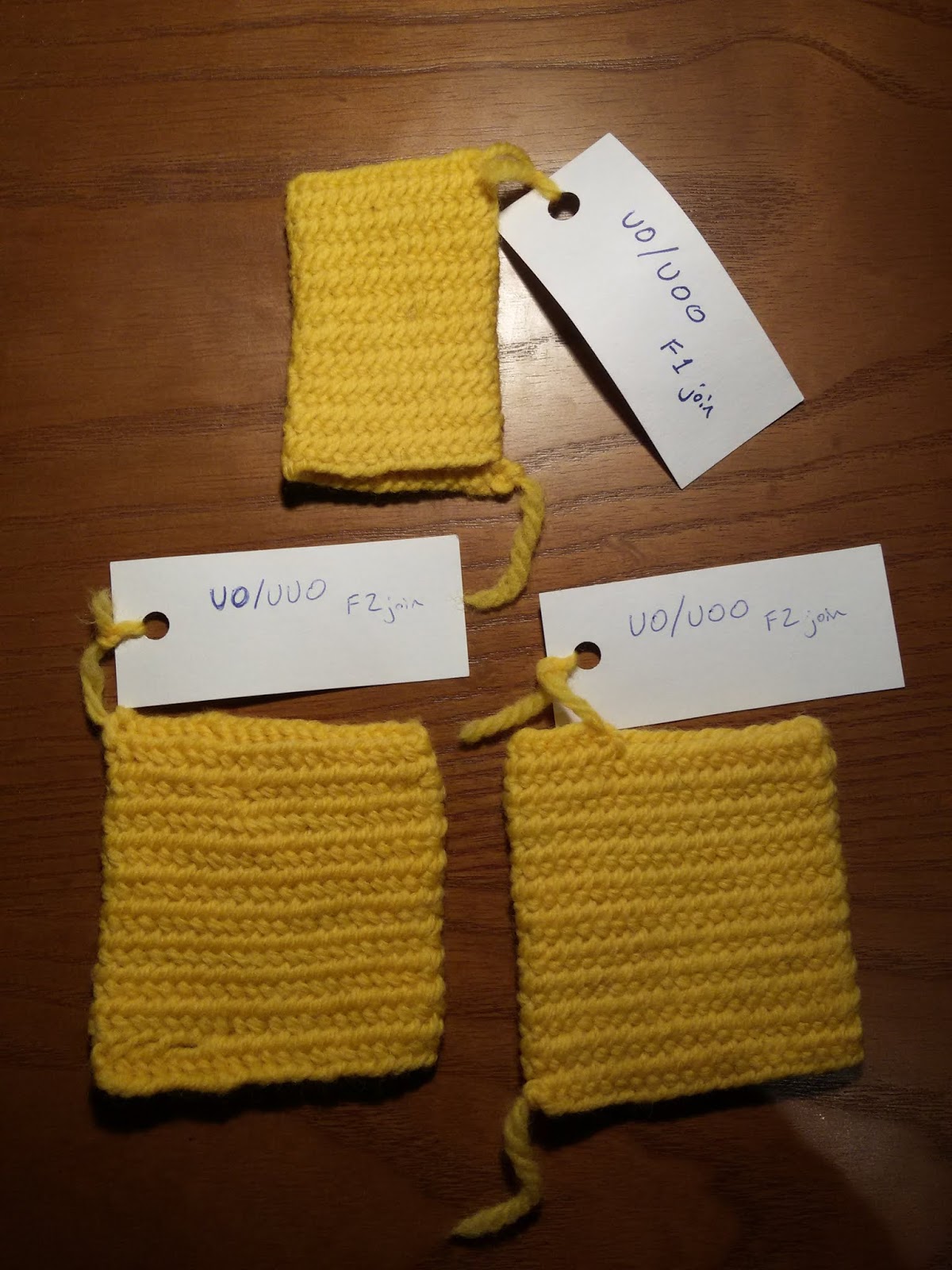
The most common stitches in Böttcher's analysis were variants of the Mammen or Korgen stitch (UOO/UUOO). There were 3 different connection stitches used with this stitch, which create slightly different looks. The first set use an F1 or F2 join. These are the most basic type of connection stitch. The needle passes through either 1 or 2 loops on the edge of the previous row, from the front.

Front side of Mammen stitch with F1 and with F2 join 
Reverse side of Mammen stitch with F1 and with F2 join
There are also examples of a joining stitch that picks up stitches from the middle of the row below. I have used a more common notation of M1 - meaning that 1 loop was picked up from the middle of the previous row. However, Böttcher uses a more precise abbreviation F(L) 2.1 - to indicate that on the front side, from the left edge of the previous row 1 stitch is picked up from the second rank of loops. (note that my photos have a sample with an M2 join, but this is not attested in the surviving examples) By joining into the middle of the previous row, the bypassed edge forms a ridge on the reverse side of the work. The surviving socks in this stitch seem to have been worked inside-out so that these ridges are on the outside.

Mammen stitch with joins to the middle of row 
Reverse side of the Mammen stitch with middle joins, showing the ridges characteristic of this connection type. 
The next group of samples are variations on the Oslo stitch (UO/UOO). This is closely related to the Mammen stitch and is often the first stitch that beginner nalbinders learn. As with the Mammen stitch, it can be done with either an F1 or F2 join. Also, like the Mammen stitch, the appearance of these two are very similar. The connection between the rows is a bit thicker with the F2 join, but otherwise they look the same. The other variation (lower left in the photos) is UO/UUO - it is a bit more awkward to do, as one loop is bypassed when making the stitch. However, as you can see, the final appearance on the front is very similar to the others (but the reverse is different).
Oslo stitch variants - front side
Oslo stitch variants - reverse side
Three of the socks in the Basel collection use a single-phase stitch - that is, one where the needle passes through all loops in the same direction, rather than weaving in and out. These are related to the stitch used in the famous Coppergate sock found in York. The York or Coppergate stitch is UU/OOO F2. The variants described by Böttcher are UU/OOO F3 and UUU/OOOO F4. The appearance of all is basically the same. However, the difference is more apparent when the work is held in the hand. This stitch basically creates a spiral of yarn for each row. The joining stitches travel through the center of this spiral. So, when an F4 join is used, there are 4 yarns in the middle of the spiral at any given point. This results in very pronounced ridges. The sample with an F3 join has less pronounced ridges, as there are only 3 yarns in the center of each row's spiral. The York stitch (not shown here) is smoother, as there are only 2 yarns in the center of each row's spiral.

Single phase stitches - front side
Single phase stitches - reverse side (same appearance)

The last stitch is highly unusual. In fact, it is almost impossible to describe with Hansen's notation. The basic stitch is simple enough - it is the Danish stitch, one of the most simple types of nalbinding stitches. Böttcher's attempt to describe it is B(L) 2.2 U/OU. By this she means that the connection stitch is made from the back of the work, taking 2 loops in the second rank from the left (or top) edge of the previous row. As always, a picture is worth a thousand words.

This is Böttcher's diagram of the stitch. The left side is showing the front (outside) and the right side shows from the reverse. I made my sample before I had gotten a photo of the sock itself. My sample has a much higher tension than the museum's sock, creating a very dense, almost double-thickness fabric. The actual sock is kind of lacy and looks more like these diagrams.

Front side 
Reverse side
I have my doubts as to whether this sock is actually nalbound. None of the items in the Basel collection have been carbon-dated. A few items have the specific location where they were found listed, but in general the museum's records generally just state "Egypt, nalbinding" with no further information on provenance. It is possible that these socks were acquired as a lot. The appearance of the sock itself is strikingly similar to crochet and the structure, as diagrammed by Böttcher, can be produced in more than one way. For more details on the ways in which different yarn-looping techniques can produce identical structures, I highly recommend the Loopholes blog which explores various yarn-looping techniques. The specific post linked to here contains a diagram of asymmetrical chain loops that looks a lot like the diagram above.

So, those are all the stitch variants I have found attested in surviving nalbound socks from Egypt. It's important to note that the Mammen F2 and Mammen M1 stitches are the only ones for which more than one or two examples are attested. Whether this relates to the actual frequency of use in the period is an open question, since it's almost impossible for us to know how representative a sample the surviving socks are. Additionally, the number of socks in the Coptic stitch is far greater than the number in complex stitches. Again, it is impossible to know how accurately this reflects the relative frequency of production in the period. But, it is quite likely that socks in the Coptic stitch were significantly more common than those in complex stitches.

Lastly, for more details on how to make these stitches, including videos, I highly recommend the marvelous Neulakintaat website. Happy stitching!


Friday, September 21, 2018

My reproduction socks


     So, now that I've described the surviving socks from post-Roman Egypt, I can show off my reproduction attempts.  Since I do not spin, I was working with commercial yarn.  The gauge of the extant socks in Coptic stitch is generally between 8 and 12 stitches per inch.  Estimating stitch gauge of the complex stitches is a bit more difficult, but as best I can determine, the yarn thickness is comparable in the complex stitch socks, if not slightly thicker.  I was able to obtain a gauge of 8.5 stitches per inch in the Coptic stitch with fingering weight/sock yarn. 

     My first attempt at making these socks was a bit of an experiment.  For teaching purposes, I made one sock in nalbinding and then reverse-engineered a pattern in order to knit the other one.  This was educational for me, but also helps me when I'm teaching about nalbinding.  It allows me to show students both how similar twisted-stitch knitting is to Coptic nalbinding and how one can distinguish between the two.  I chose red, since it's well documented among the surviving socks.  The adult size socks in Coptic stitch are generally all one color.


     You can see the cords tied around my ankles in the photo.  This seems to be the way these type of socks would have been worn.  Since I had very little information to go on as far as making the cords, I did a simple finger-loop braid of 3 loops.

     For my second pair of socks, I was trying to perfect the fit around the heel and ankle.  You can see in the photo above that the red socks are a bit loose around the heel and ankle.  I determined that I started the heel flap too soon, which results in the ankle being too big.  I also made the heel flap a bit too wide, which causes the corners in the back to poke out, rather than lay flat against the foot.  I did correct these defects in the second pair of socks.  This photo shows what I think should be the correct fit around the heel.


     I chose to make my second pair out of a very non-descript brown color of wool.  These have an undivided toe.  I decided to do this, since I was focusing on the fit of the heel and ankle.  However, it turned out not to be any less time consuming than constructing a split-toe sock.  Something that did strike me when taking photos of the socks, though, was that they curl up in a very similar manner to the socks in the museums (when the curators have not mounted them on foot-like or not-so-foot-like stand).  This is due to the nature of the Coptic stitch.


     For the second pair, I was able to look for more detail in the surviving socks about how the cord ties might have been made.  In one particular sock from the British Museum, there are surviving remnants of a cord around the ankle.  It is a simple twisted cord, appearing to be the same width as the welt across the top of the instep (which takes on a twisted-cord appearance due to the way in which the sections are joined).  So, I took a length of the same yarn I used to make the sock and doubled it, overtwisting in the same direction as the yarn's twist.  I then pulled it through a couple stitches at the corners of the front slit before letting it double back on itself to ply into a twisted cord.  This method was incredibly simple and worked well.


     My third pair was an attempt to replicate some of the complex stitch socks.  I chose to use the UOO/UUOO with an F2 connection, since this seems to be the most common complex stitch among the Egyptian socks.  Since there are examples of both split toes and undivided toes among the complex stitch socks, I chose to make a pair with split toes.


     The adult socks in complex stitches display more types of stripes than the Coptic stitch ones.  So, I decided to go a little nuts and make this pair flashy.  One thing I would do differently in a future pair is that the heel flap on this pair came out too short.  Since the coplex stitch socks use a triangular heel flap, rather than a rectangular one, I was decreasing on either end of the short rows of the heel flap.  The rate of decrease ended up making a flap shorter than I really needed to fit my foot.  I thought that the stretch of the fabric would even that out, and it kind of did.  However, I noticed that some of the extant socks have a couple rows worked back and forth along the edges of the heel flap before the work continues around to form the top of the heel and the ankle/leg section.  Like this sock from the British Museum:


Was this a way of adjusting for a too-small heel flap?  It's hard to know for sure, but it can certainly work that way.  And had I noticed this earlier, I might have tried it.  This will be something I can try for a future pair if I run into this same fitting problem again.

     So, these are my Egyptian style socks so far.  More to come, hopefully.


Thursday, September 13, 2018

Socks from Post-Roman Egypt (background)


[This is a recompilation of the information I had put together to present the work I've been doing with re-creating Egyptian nalbound socks. I presented this for our Provincial A&S champions competition, the Keeper of the Central Flame competition this spring, and at the Pennsic A&S display this year. I'm putting this up here because I've had several people who were interesting in learning more about my socks.]


Cultural Background
     Due to the climate in Egypt, the conditions there are very favorable for the preservation of textiles in archaeological contexts. There is therefore a huge number of textiles and textile fragments from various eras of Egyptian history, extant in museums around the world. Many museums hold socks from Egypt dating to the post-Roman (sometimes called Coptic) period, roughly the 3rd to the 7th centuries CE.

     Egypt became a part of the Roman empire in approximately 30 BCE. (Wikipedia) However, aside from some high-ranking imperial officials, the majority of the “Romanized” population in Egypt remained Greek-speaking and could more properly be described as “Hellenized”. When we speak of “post-Roman” Egypt, we are really speaking of the period following the division of the Roman empire into its Eastern and Western halves. Egypt remained under the rule of the Eastern Roman (Byzantine) empire until it was conquered by the expanding Arab Muslim empire in the 7th century CE.

     Culture within Egypt during this time, including fashions in dress, was a mixture of Hellenic, Roman, and native Egyptian practices. The period is characterized by the dominance of Christianity and the development of the Coptic church (a uniquely Egyptian sect which survives to this day). Most of the surviving socks come from Greek-speaking Christian sites within Egypt and should be understood in that context. While most of the surviving socks have been dated to the post-Roman era (3rd-7th centuries), more recent radio-carbon dating has confirmed that some may be from as early as the 1st century, CE. Even these earlier centuries in Egypt still represent a mixture of Hellenized Roman and native Egyptian culture, but without the dominant influence of Christianity.


Surviving socks
     In order to understand the socks from Egypt, it is necessary to discuss briefly the types of shoes worn in this period. Figure 1 (Burandt) shows the types of shoes common in the Roman empire. In addition to these characteristically Roman styles, a more typically Byzantine style is also found in Egypt during this period, usually described as a slipper – see photo below. The Metropolitan Museum of Art indicates that “Written evidence suggests that sandals [soleae] were worn by government officials, slippers by monks and clergy, and boots by soldiers and laborers; the poorest members of society would have gone barefoot.” (Metropolitan Museum of Art, display placard). Many varieties of socks can be worn with the carbatinae, caligae, and slippers. However, due to the presence of a leather thong between the first and second toes (similar to modern flip-flops), soleae, if worn with socks, require a specially made sock with separate compartments for the first toe and the minor toes.


Figure 1 - from Burandt, Boris. "Iron-footed hobnail patterns under Roman shoes and their functional meaning." Small Finds and Ancient Social Practices in the Norhtwest Provinces of the Roman Empire. ed. Stephanie Hoss & Alissa Whitmore (Oxbow Books) 2016. 

Slipper type shoes at the Metropolitan Museum in New York (photo by me) 

There are two main types of surviving socks from the Roman empire, including from Roman Egypt, and from post-Roman Egypt: socks made from woven cloth and socks made with the nalbinding technique. (Kostner) My focus here is on the socks made with nalbinding. These can be further divided into those employing the Coptic stitch (also referred to as “Coptic knitting”, crossed looping, and Tarim stitch) and those employing more complex nalbinding structures.


Nalbinding
     Nalbinding (also called needle-looping or knotless netting) is made using finite lengths of yarn on a needle with an eye using a technique similar to sewing or embroidery. The yarn is formed into a series of loops which form a flexible and stretchy fabric. The structure of the Coptic stitch is very basic. Each stitch is a simple loop that crosses behind (or in front of) itself. In forming each stitch, the needle passes behind a stitch in the previous row, specifically passing behind the part of the stitch where the yarn crosses itself. (Figure 2) This stitch is employed in the majority of surviving socks from Egypt.

Figure 2 - The structure of Coptic stitch nalbinding. 

     There is one child’s sock (Photo 1) which employs a variant in which the connection to the previous row passes through the loop, rather than behind the crossing of the previous row’s stitch. (analysis mine) The Coptic stitch is also found outside of Egypt.
 
Photo 1 - from the Victoria & Albert Museum (item 1287-1904)   http://collections.vam.ac.uk/item/O128879/sock-unknown/ 

     I am using the phrase “complex stitch” in this context to refer to any stitch structure other than the Coptic stitch (or it's variant of 'pierced looping'). In complex nalbinding stitches, each stitch connects through one or more stitches in the same row. In the Coptic stitch, as can be seen in Figure 2, each stitch only connects with stitches in the row above and the row below. There are many possible variants of the complex nalbinding stitches, and these are common in other European contexts, such as the many examples from Scandinavia. At least 9 different stitch structures have been documented in socks from post-Roman Egypt. (Bottcher) I will use Hansen’s notation for nalbinding structures to refer to specific stitches.

     In either case, the nature of nalbinding and the way the stitches and rows form makes it especially suited to creating tubular and bag-like structures. So, it is especially suited for making socks. The elastic nature of the resulting fabric helps create a close fit as well, which is also advantageous in a sock.

Socks in Coptic stitch
     The vast majority of socks in the Coptic stitch have a division between the first toe and the lesser toes. This indicates use with soleae or a similar type of sandal. While there do exist socks of this type with an undivided toe section they are by far in the minority. Even socks made to fit infants or toddlers exhibit the characteristic divided toe.

     The overall structure of socks in the Coptic stitch is remarkably consistent. In addition to having a divided toe, the heel is shaped in essentially the same manner in all the surviving socks of this type. This structure was described by Dorothy Burnham in a study of the socks from two museum collections. (Burnham) Analysis of socks from other collections has so far not revealed any exceptions to the construction method she describes. The two toe sections are worked separately, beginning with a small ring of stitches and working up from the tips. The lateral section is shaped by a series of increase stitches on the lateral edge. The two sections are then joined and the foot section is worked up to the instep. A heel flap is worked back and forth to create the heel part of the sole and the work is interrupted at the back of the heel. A square heel is formed (occasionally with the last few rows getting narrower) as the work continues back and forth to create the sides and back of the heel part. When the sides of the heel have reached the proper height, work resumes in the round, usually creating a welt across the top of the instep (continuous with a welt formed on either side of the heel). This welt, while serving as the functional connection between the foot section and the heel/ankle section, is also decorative and resembles a twisted cord. All of the known socks worked in the Coptic stitch are ankle-length.

Photo 2 - from the Victoria & Albert Museum (Item 2085&A-1900)   http://collections.vam.ac.uk/item/O107787/pair-of-socks-unknown/ 

     The primary type of variation seen among these socks is in the way the top is finished. (Photo 2-4) There are some socks which are simply worked up to the top edge in the same manner, forming a plain top. Some have ribbing, created by working some columns of stitches into the previous rows from the back to the front, rather than front to back (analagous to purling in knitted material). The most common finish at the top is a single vertical slit at the front of the ankle (created by working back and forth again, once the lower portion of the ankle is formed. These socks generally have remains suggesting the presence of cords attached to the corners and some have surviving cordage. At least one sock has two slits, creating a tongue in the center of the front ankle with lacing either on both sides or running over it. 
 
Photo 3 - from the Victoria & Albert Museum (Item 1243-1904) http://collections.vam.ac.uk/item/O128875/sock-unknown/ 
Photo 4 - from the Victoria & Albert Museum (Item 1936-1897) http://collections.vam.ac.uk/item/O128867/sock-unknown/ 

     The adult size socks in Coptic stitch are almost universally monochrome. The children’s socks are often formed of multicolored stripes. (Photos 1, 5) The surviving socks are dyed in bright and dark colors, and examples of every color in the spectrum can be found. There are also examples in white and off-white colors as well. The socks in Coptic stitch that I have found are all made of wool. There are examples of S- and Z-spun yarns, and 2-ply, 3-ply, and 4-ply yarns have been described. The gauge is generally in the range of 8-12 stitches per inch (roughly 3-5 stitches per cm).


Photo 5 - from the Manchester Museum https://egyptmanchester.wordpress.com/2012/03/22/curators-diary-22312-of-sling-shots-and-coptic-socks/ 

Socks in complex stitches
     The socks worked in complex stitches are less common than those worked in Coptic stitch. There are many stitch types employed in the surviving examples. The Museum der Kulturen in Basel, Switzerland has an especially large collection of Egyptian socks in complex nalbinding stitches. There are 9 different stitch types represented in this collection. (Bottcher) There are 3 items using single-phase stitches (UU/OOO and UUU/OOOO) and over 20 items using 2-phase stitches (with the most common by far being UOO/UUOO with two different types of connecting stitches). In addition, Bottcher includes one item with a very unusual stitch type, not easily described in Hansen’s notation. I have not found any published analysis of the stitch types in socks from Egypt in other collections. However, my conclusion, based on photographs of the socks (Photos 6 and 7) is that these are probably of the UOO/UUOO or UO/UOO stitch type (both of which are attested in Bottcher’s sample).

Photo 6 - from the British Museum (item EA72502) http://www.britishmuseum.org/research/collection_online/collection_object_details/collection_image_gallery.aspx?partid=1&assetid=1031262001&objectid=118868 

     Socks in complex stitch types are more likely to have an undivided toe than those in Coptic stitch. Those with split toes and those with undivided toes are both common among the examples I have found (with undivided toes being slightly more common in this group). There are several reasons why this may be. Firstly, the complex stitches create a slightly thicker fabric (assuming the same thickness of the yarn) than the Coptic stitch does. Having additional thickness in between the toes would be less comfortable when wearing soleae type sandals. Second, because the complex stitches can produce a thicker fabric, they may have been used when a warmer foot covering was desired. This desire for warmth may or may not correlate with the use of closed shoes, thus explaining the presence of complex stitch socks with split toes. There does not seem to be any correlation between the size of the socks (adult vs. child) and the use of split vs. undivided toes.


Photo7 - from the Museo Archeologico Nazionale Florence via Global Egyptian Museum (Inventory # 12920) http://www.globalegyptianmuseum.org/record.aspx?id=9130 

     The heel construction of complex stitch socks is different from that used for the Coptic stitch socks, but is also remarkably consistent throughout the samples. Whether or not the toe is split, the foot portion of the sock consists of a tube worked up to the instep. The heels of these socks are composed of a series of short rows forming a triangular or trapezoidal shape extending back from the sole of the foot portion. The steepness of the triangle sides varies somewhat, but the general shape is nearly universal. The stitching then resumes from the front/instep along the ends of the short rows and continues up into the ankle/leg portion. (Photos 6-9)
Photo 8 - from the Museum der Kulturen Basel (Item III 15479)
     The complex stitch socks vary in length as well. This is consistent with the variation in the types of closed-toe shoes worn in the Roman empire and Byzantine empire. Some of the socks are ankle length, like the Coptic stitch ones. But other socks appear to be mid-calf or calf length. None of the complex stitch socks have structural variation at the cuff. However, some have decorative color patterns at the cuff. (see Photo 9)

Photo 9 - from the Museum der Kulturen Basel (Item III 15397) 
     These socks also display a wide range of colors. Most of them are made of wool. I have found very little information on the details of the yarn in these socks (thickness, spin direction, plies, etc.). However, some of the complex stitch socks are made of linen or cotton. The vegetable fiber socks are all primarily white or off-white; one has a small number of stripes in a blue color (probably from indigo) that are only one or two rows wide.


Conclusions and wider implications
     There have not been any finds of socks in the nalbinding technique from elsewhere in the Roman or Byzantine empires. It is clear from the large number of surviving Egyptian socks that they must have been a fairly common item there in the post-Roman era. The use of radio-carbon dating to establish that some of these socks date to the era of Roman rule in Egypt, plus their discovery mostly in Greek-speaking enclaves, suggest that they may have been a Roman (or Hellenized) fashion, rather than one developed in the Egyptian tradition. So, is there any evidence that nalbound socks were used elsewhere in the Roman empire?

     There is textual evidence of the use of socks throughout the Roman empire. (Kostner) There are surviving socks sewn from woven cloth from the areas of modern-day France and Britain. (Kostner) However, none of the socks found outside of Egypt have a split toe, meaning they could not have been worn with soleae. Kostner includes in her article a photo of a funerary stele from southern Germany clearly depicting a woman wearing soleae with socks. It is likely that people in the northern and northwestern provinces were wearing soleae (this seems to have evidence from other sources as well – as noted in the explanatory placard from the Metropolitan Museum quoted at the beginning of this post, there was a certain social implication to a person's choice of footwear).  So, it seems likely that they would have seen the need for socks in the colder climates of Rome's northern provinces. There is evidence of comtemporary use of nalbinding in northern Europe (Classen-Buttner) So, it is certainly possible that this technique, known in Roman Egypt and used elsewhere in northern Europe, could have been widely used in the Roman empire. However, this will have to remain speculation unless or until someone finds more definitive pictorial evidence or an extant example.


References

Bozsa, Isabella. Museum der Kulturen Basel, private correspondence, 2018.

Böttcher, Gudrun. “Nadelbindung – Koptische Textilien im Museum der Kulturen Basel und im Städtischen Museum Simeonstift, Trier” Archaeological Textiles Newsletter. No. 39, Autumn 2004.

Burandt, Boris. “Iron footed – hobnail patterns under Roman shoes and their functional meaning.” Small Finds & Ancient Social Practices in the Northwest Provinces of the Roman Empire. Ed. Stephanie Hoss & Alissa Whitmore, (Oxbow Books) 2016.

Burnham, Dorothy. “Coptic Knitting: an ancient technique.” Textile History. vol. 3, No. 1, Dec 1972. pp 116-124.

Claßen-Büttner, Ulrike. Nalbinding – What in the World Is That?, Books on Demand, 2012.

Collin, Maria. “Sydda Vantar.” Fataburen, Nordiska Museet Fataburen, 1917. pp 71-82

Hansen, Egon H. “Nalebinding: definition and description”. Textiles in Northern Archaeology, NESAT III: Textile Symposium In York, 1990.

Kendrick, AF. Catalogue of textiles from burying-grounds in Egypt, Victoria & Albert Museum, London: H. M. Stationery Office, 1920-21.

Köstner, Barbara. “Wearing socks in sandals: The height of Roman fashion?” Small Finds & Ancient Social Practices in the Northwest Provinces of the Roman Empire. Ed. Stephanie Hoss & Alissa Whitmore, (Oxbow Books) 2016.

Leroux, Ernest, ec. Le costume en Egypte du IIIe au XIIIe siècle. Paris:Palais du Costume, 1900.

Schinnerer, Luise. Antike Handarbeiten, Vienna, 1895.

Wikipedia contributors. "Egypt (Roman province)." Wikipedia, The Free Encyclopedia. Wikipedia, The Free Encyclopedia, 29 Mar. 2018. Web. 13 Apr. 2018.
https://en.wikipedia.org/wiki/Egypt_(Roman_province)


Museum Catalogs
The British Museum - http://www.britishmuseum.org/research/collection_online/search.aspx
Global Egyptian Museum (collates collections from numerous museums worldwide) - http://globalegyptianmuseum.org/
The Manchester Museum - https://egyptmanchester.wordpress.com/2012/03/22/curators-diary-22312-of-sling-shots-and-coptic-socks/
The Metropolitan Museum of Art - https://metmuseum.org/
Victoria & Albert Museum - https://www.vam.ac.uk/archives/


Sunday, October 08, 2017

I did a guest blog!

I don't know if anyone is actually reading this blog or not.  But, in case someone is, they may be interested to know that I just did a guest blog entry on the Loopholes blog.  Loopholes is run by a retired museum curator with an interest in fiber arts and particularly looped-yarn textiles.

Following a really interesting discussion of the evolution of nomenclature for nalbinding, he has gotten into the intersection of knitting and nalbinding in Egypt - a topic of some interest to me as well.  After I had commented on a recent post, he asked me to do a guest blog about some knitted tubes from Coptic Egypt.  The result is this blog entry

I figure that anyone following this blog would probably be interested.


Friday, April 07, 2017

Nalbinding & Knitting: compare and contrast

Here are some excerpts from a poster presentation I did at an SCA event in August 2016.  It was a research-focused event hosted at U Penn, where people had the opportunity to share the results of their research.

These diagrams are analyzing the so-called Coptic stitch.  For more information on the Coptic stitch in nalbinding, see my other post on Egyptian socks: here.  So, the interesting thing about this particular nalbinding stitch is that it looks very similar to knitting.  Specifically twisted-stitch, or crossed-stitch, knitting.  This has led to some confusion among archaeologists and there are probably textile fragments in museum collections that have been mis-categorized.

The point of this analysis (which was illustrated with some samples on the poster) was to show the ways in which knitting and Coptic nalbinding can be distinguished from each other.  The structure of Coptic nalbinding, when worked flat or in a constant-size tube, is identical to that of twisted knitting.  However, they are worked in opposite directions.  Because of the differences in the way they are worked, the two structures can be differentiated by looking at the increases and decreases.  Some increase or decrease structures are unique to nalbinding, some are unique to knitting, and some can be created in both techniques.

The below terms in red (other than the 'F1 increase') are my own, since I could not find any categorization of the different types of increases and decreases which are possible with the Coptic stitch.  If anyone knows of one, do please let me know.


Distinguishing Nalbinding from Knitting: 
Increases and Decreases

Increases add a stitch to the row being worked, and decreases reduce the number of stitches, compared to the previous row.  Nalbinding increases are analagous to knitting decreases (and vice-versa).


Nalbinding:
F 1 increase – made by passing the yarn around the bridge between 2 stitches.  All of the increases in the extant socks that I have been able to analyze are of this type.
 Impossible to replicate with knitting.


Nalbinding:
Linked increase – 2 stitches are worked around the same stitch
Structure is the same as ‘knit-2-together’ or ‘purl-2-together’ knitting decreases.


Nalbinding:
Skip decrease – made by simply skipping one stitch of the prior row


Structure is the same as ‘lifted’, ‘make-one’, or ‘yarn-over’ knitting increases


Nalbinding:
Joined decrease – made by passing the stitch behind 2 adjacent stitches of the prior row.
Looks similar to a ‘knit front-and-back’ or ‘bar increase’ with proper tension, but structurally different.  COULD be replicated exactly with knitting, but this is not generally done.       


Egyptian Coptic Nalbinding

Here is the handout for a class I teach on Egyptian nalbinding.

Nalbinding is a technique for creating a stretchy fabric.  It predates knitting and seems to have been developed independently in various parts of the world.  It is most well-known in the Scandinavian context and the term 'nalbinding' is a Scandinavian word, but all the English equivalents are unwieldy so most English-speaking people keep using the term 'nalbinding'.  However, there seems to have been a strong tradition of nalbinding in Roman era and Post-Roman era Egypt as well.

Nalbinding creates a fabric by creating loops with yarn or thread.  The yarn is worked with a blunt sewing needle.  For wonderful instructions on many varieties of nalbinding, you can check out this site for instructions, videos, and all kinds of great reference material.

The socks from Egypt are mostly (but not all) worked in a stitch referred to as the "Coptic stitch".  The term Coptic has been used to refer to the Post-Roman era, which is the period of time between the end of Roman rule in Egypt (roughly 3rd century) and their conquest by the Muslims (7th century).  It can be a bit confusing because Coptic also refers to a sect of Christians based in Egypt.  We do not know if these socks were worn by Coptic Christians.  In fact, most were found in excavations at Greek colony cities in Egypt.

This handout is a collection of images I've found from various museums' digitized collections, followed by the illustrations I use in teaching people how to do the Egyptian style nalbinding.

Nalbound socks from Egypt